

Follow the steps below to get started with the Agent Connect Framework which will enable your agent to integrate with watsonx Orchestrate.
1

Enable your agent for collaboration

To make your agent compatible with watsonx Orchestrate, you need to implement the Agent Connect API endpoints. The primary endpoint is the chat completion endpoint, which follows the OpenAI chat completions format.
1

Set up your server

First, create a server that will host your agent’s API endpoints. You can use any web framework in your preferred language. Here are a few examples using Express.js, Flask and Go’s standard library:
const express = require('express');
const app = express();
app.use(express.json());

const PORT = process.env.PORT || 3000;

app.listen(PORT, () => {
    console.log(`Agent server running on port ${PORT}`);
});
2

Implement the chat completion endpoint

Add the chat completion endpoint to your server:
app.post('/v1/chat', async (req, res) => {
    try {
    const { messages, stream = false } = req.body;
    
    // Get thread ID from header if present (for stateful conversations)
    const threadId = req.headers['x-thread-id'] || 'default';
    
    if (stream) {
        // Set up SSE streaming
        res.setHeader('Content-Type', 'text/event-stream');
        res.setHeader('Cache-Control', 'no-cache');
        res.setHeader('Connection', 'keep-alive');
        
        // Process messages and stream response
        await streamResponse(res, messages, threadId);
    } else {
        // Process messages and return complete response
        const response = await processMessages(messages, threadId);
        res.json(response);
    }
    } catch (error) {
    console.error('Error processing chat request:', error);
    res.status(500).json({ error: 'Internal server error' });
    }
});
3

Implement the agent discovery endpoint

Add the agent discovery endpoint to allow your agent to be discovered:
app.get('/v1/agents', (req, res) => {
    res.json({
        agents: [
        {
            name: 'My Custom Agent',
            description: 'A specialized agent that helps with specific tasks',
            provider: {
            organization: 'Your Organization',
            url: 'https://your-organization.com'
            },
            version: '1.0.0',
            capabilities: {
            streaming: true
            }
        }
        ]
    });
});
4

Implement message processing logic

Create functions to process messages and generate responses:
async function processMessages(messages, threadId) {
    // Your agent's logic to process messages and generate a response
    // This is where you would integrate with your LLM, tools, etc.

    const response = {
        id: generateId(),
        object: 'chat.completion',
        created: Math.floor(Date.now() / 1000),
        model: 'your-agent-model',
        choices: [
        {
            index: 0,
            message: {
            role: 'assistant',
            content: 'This is a response from your agent.'
            },
            finish_reason: 'stop'
        }
        ],
        usage: {
        prompt_tokens: 0,
        completion_tokens: 0,
        total_tokens: 0
        }
    };

    return response;
}

async function streamResponse(res, messages, threadId) {
    // Example of streaming a response with thinking steps and tool calls

    // Stream thinking step
    const thinkingStep = {
        id: `step-${generateId()}`,
        object: 'thread.run.step.delta',
        thread_id: threadId,
        model: 'your-agent-model',
        created: Math.floor(Date.now() / 1000),
        choices: [
        {
            delta: {
            role: 'assistant',
            step_details: {
                type: 'thinking',
                content: 'Analyzing the user request and determining the best approach...'
            }
            }
        }
        ]
    };

    res.write(`event: thread.run.step.delta\n`);
    res.write(`data: ${JSON.stringify(thinkingStep)}\n\n`);

    // Wait a moment to simulate processing
    await new Promise(resolve => setTimeout(resolve, 1000));

    // Stream final message
    const messageChunk = {
        id: `msg-${generateId()}`,
        object: 'thread.message.delta',
        thread_id: threadId,
        model: 'your-agent-model',
        created: Math.floor(Date.now() / 1000),
        choices: [
        {
            delta: {
            role: 'assistant',
            content: 'This is a streamed response from your agent.'
            }
        }
        ]
    };

    res.write(`event: thread.message.delta\n`);
    res.write(`data: ${JSON.stringify(messageChunk)}\n\n`);

    // End the stream
    res.end();
}

function generateId() {
    return Math.random().toString(36).substring(2, 15);
}
5

Deploy your agent

Deploy your agent to a publicly accessible URL. You can use platforms like:
  • IBM Cloud Code Engine
  • AWS Lambda
  • Google Cloud Run
  • Your own infrastructure
Ensure your agent is accessible via HTTPS for security.

Using an open source agent framework?

Check out our examples for ideas on how to use popular open source frameworks with Agent Connect.
2

Log in to watsonx Orchestrate

To connect your agent with watsonx Orchestrate, you need to log in to an IBM watsonx Orchestrate account.
3

Register your agent with watsonx Orchestrate

Now that you deployed your agent and you have access to watsonx Orchestrate, you can register your agent.
1

Install the ADK

Navigate to Installing the ADK to learn how to install the ADK.
2

Register an external agent

For more information, see External Agents .
3

Deploy your agent

For more information, see Deploying Agents .
1

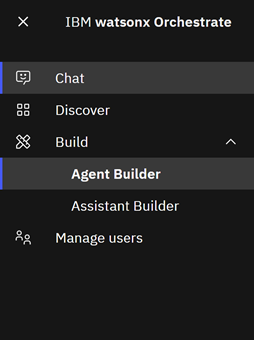
Open the Agent Builder

Navigate to Build > Agent Builder.
2

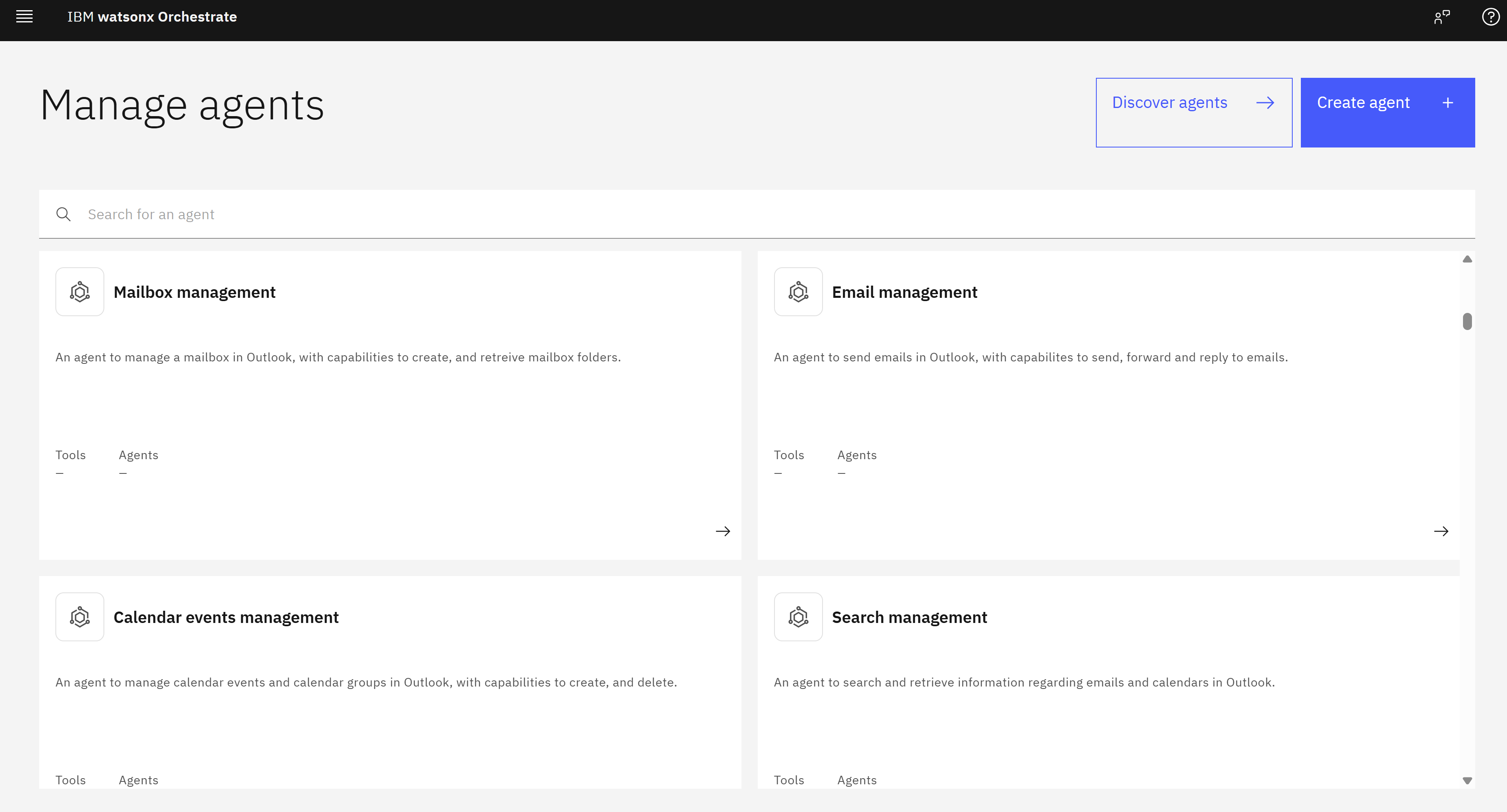
Select an agent

Select an agent from the catalog.
3

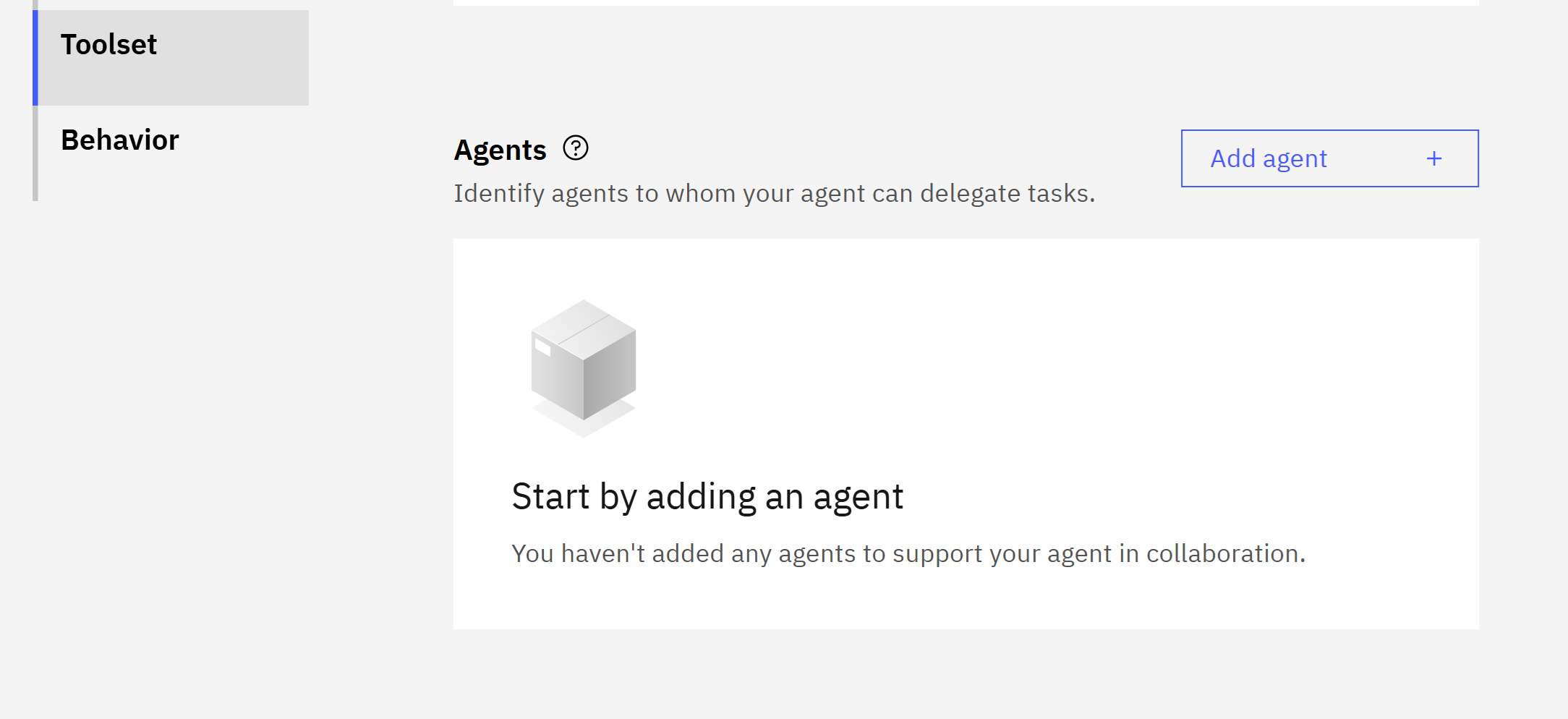
Add your agent

From the Toolset, click Add agent.
4

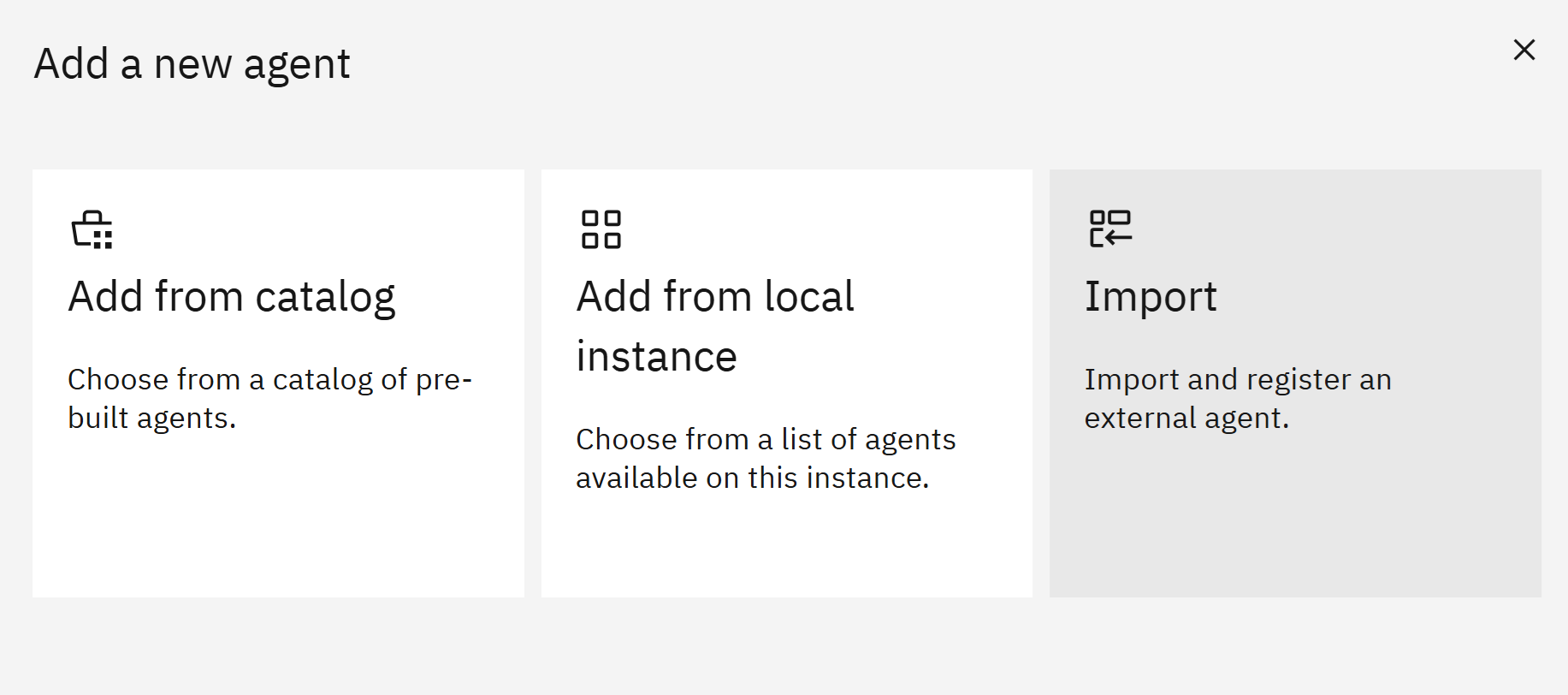
Import agent

Click Import to import your external agent.
5

Add external agent

On the Import agent screen, select External agent and click Next.
6

Add agent information

Provide the following details:
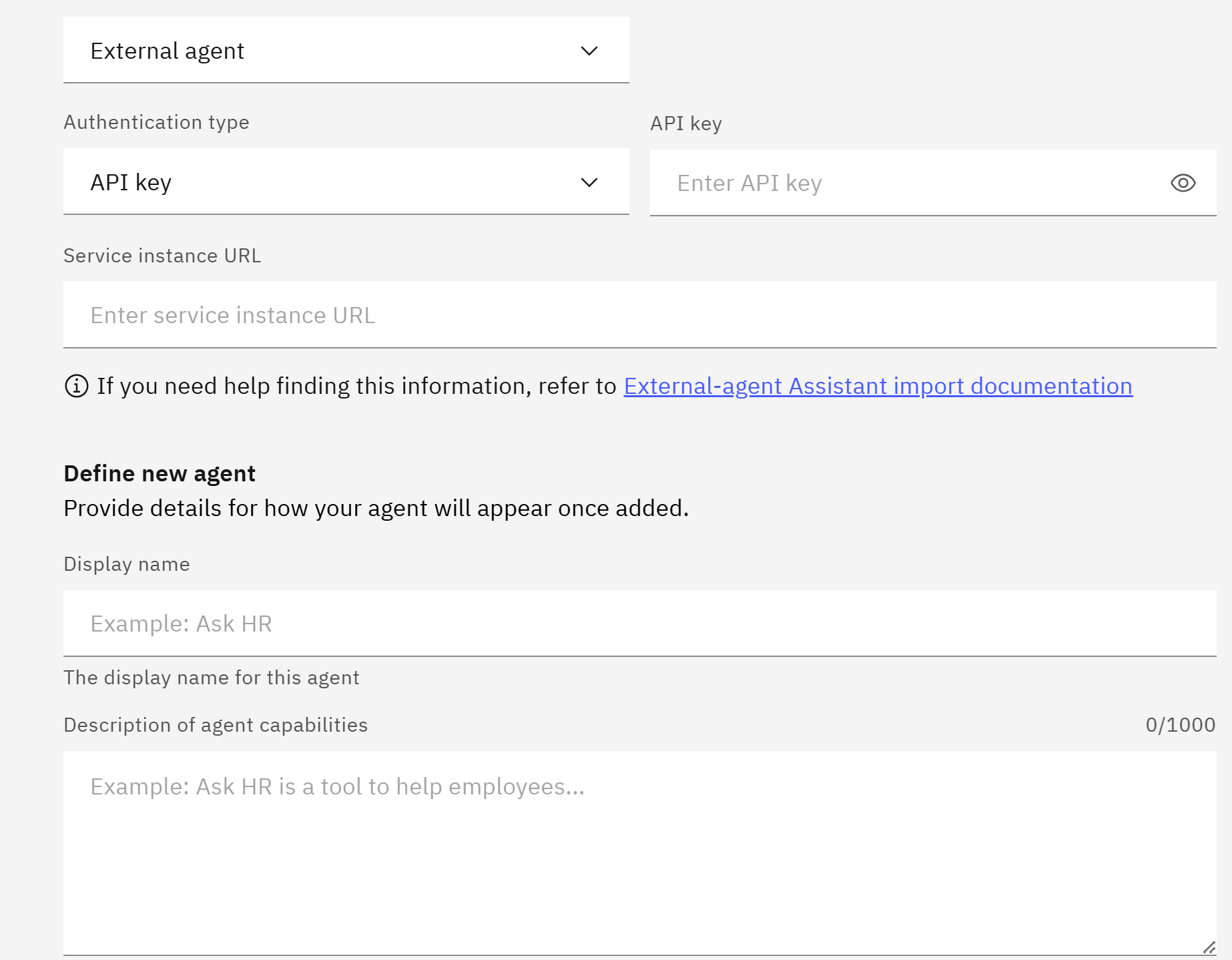
  • Authentication: Specify the type of authentication and the credentials for your agent.
  • Service instance URL: The URL endpoint of your agent’s chat API (for example, https://your-agent.example.com/chat).
  • Display Name: A user friendly name for your agent.
  • Description: An intuitive description of what your agent does and how it should be used.
Click Import Agent to finish the process.
7

Test your agent

Use the chat preview to test your agent.

Next Steps

Now that you’ve successfully integrated your agent with watsonx Orchestrate, you can explore more advanced features: